


This quote has been on my mind lately:
“The future is not some place we are going to, but one we are creating.”
It’s from the 1981 book Legitimacy in the Modern State by political theorist John H. Schaar.
What’s interesting to me is more than the quote itself. It’s its age.
Schaar wrote those words more than four decades ago. Before the internet became commonplace. Before smartphones. Before cloud computing. Before artificial intelligence entered the public consciousness.
And yet, here we are in 2026, still wrestling with systems that often struggle to think beyond immediate needs and short term outcomes.
I keep coming back to that.
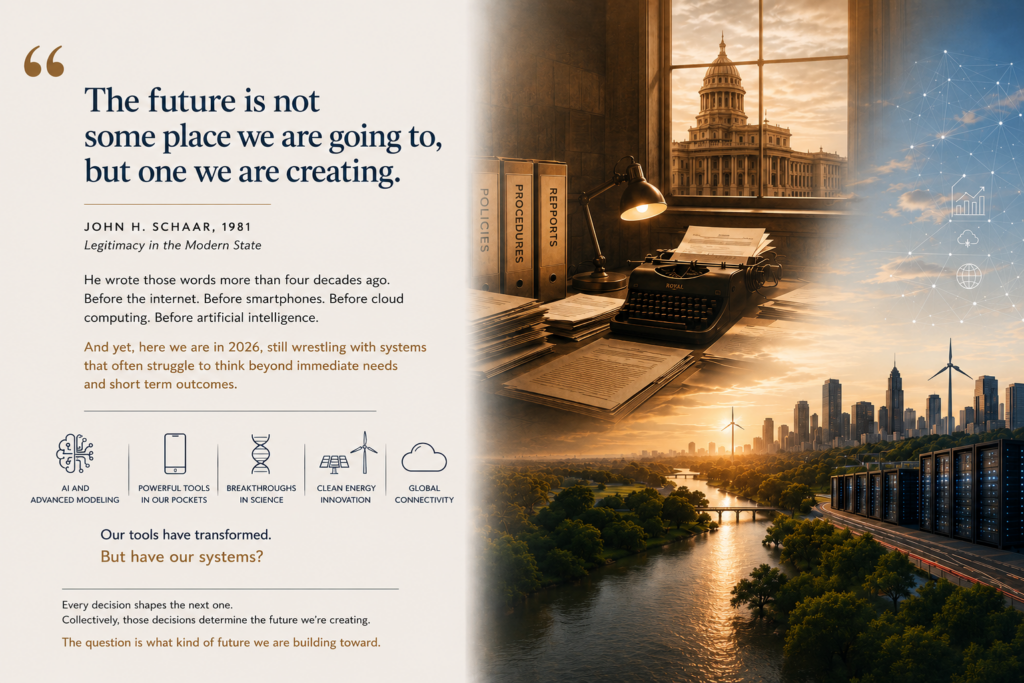
We’ve transformed nearly every aspect of technology since 1981. We can sequence genomes, carry supercomputers in our pockets, and ask AI to solve problems that once required teams of specialists.
But when it comes to planning, approving, procuring, and building infrastructure, I sometimes wonder how much has really changed.
Many of the models that shape our decisions would still feel familiar to someone working in government decades ago.
It’s tempting to point fingers at the people operating within those systems. I think that’s an oversimplification.
This is a systems problem. And not just one system. A web of interconnected systems, incentives, regulations, institutions, traditions, and expectations that have accumulated over time.
In some ways, it may be one of the most complex challenges we face.
Science has advanced at an extraordinary pace. We can model climate impacts, predict energy demand, simulate traffic patterns, optimize supply chains, and use artificial intelligence to analyze problems that once took teams of experts months to understand.
Yet many of the systems we use to plan, evaluate, approve, procure, and deliver infrastructure still rely on processes, incentives, and assumptions inherited from previous eras.
Sometimes I wonder if we’ve modernized our tools faster than we’ve modernized the methods for governing how those tools are used.
And… how well can we govern technologies and systems that we don’t yet fully understand ourselves?
Most decisions are made with good intentions.
But are we looking to the past for guidance because it feels safe? Or are we willing to explore new possibilities while still stewarding the long term resilience of the ecosystems we depend on?
Our future may depend on how we answer those questions.
By “we,” I mean all of us. Citizens. Business leaders. Engineers. Policymakers. Community leaders. Voters.
Because every decision shapes the next one. And collectively, those decisions determine the future we’re creating.
Recent news has offered several reminders that growth is beginning to stress systems that were designed for a very different world.
To me, this is not about more buildings or roads, though that is certainly part of the equation. I run a public benefit corporation, and I suppose I assumed our city, county, and state governments would naturally prioritize long term public benefit. Not only for our voting citizens and our economy, but for our ecosystem, our natural resources, our agriculture, our children, future citizens, and all the systems that create the culture that draws people to Texas.
The more I think about it, the more I wonder if we’ve become so focused on delivering projects that we’ve stopped asking bigger questions about the outcomes those projects are meant to create.
I am often surprised by how quickly some projects move in the name of progress. Sometimes without serious consideration of their long term consequences. Sometimes without challenging ourselves to develop solutions designed for the realities of the twenty first century and beyond.
It is remarkable how often “good enough” wins over “what is possible.”
Part of the challenge may be structural.
Public procurement represents one of the largest and most influential activities governments undertake. Across the Organisation for Economic Co-operation and Development (OECD), public procurement accounts for roughly 12 percent of GDP, making it one of the most powerful tools governments have to shape the future.
Yet the systems surrounding it are often designed to optimize for compliance, fairness, budget adherence, and risk reduction. Those are important goals. But they are not the same as resilience, sustainability, or innovation.
When a project reaches procurement, many of the most important decisions have already been made. The question is often no longer, “What future are we trying to create?” but rather, “How do we acquire what has already been approved?”
That approach made sense when change unfolded over generations. Today, technology, infrastructure demands, climate pressures, and population growth are evolving within a single decade.
If we want different outcomes, we may need to expand who is involved in designing solutions long before they reach the purchasing phase. Systems thinkers. Engineers. Environmental scientists. Human centered designers. Community stakeholders.
People tasked not only with asking whether a project can be delivered, but whether it is the right solution for the future we are creating.
Stepping off my soapbox for a moment, here’s a reality check…
Today, only a day after World Cup festivities began in Houston, organizers were already facing scrutiny after 22 people required treatment for heat related illnesses and four were hospitalized at a FIFA Fan Festival watch party. Temperatures were in the 90s, with heat index values climbing above 100 degrees.
We’re only at the beginning. There are still weeks of matches ahead. More visitors. More crowds. More demand on transportation, power, water, cooling systems, medical services, and public spaces.
And… have you ever been to Texas in the summer?
Anyone who has spent a summer afternoon in Houston, Dallas, Fort Worth, Austin, or San Antonio knows this isn’t exactly a surprise. Texas heat isn’t a new phenomenon. The scale of the challenge was visible long before the first match kicked off.
At the same time, Texas continues to attract massive investment in data centers and AI infrastructure. According to the Electric Power Research Institute, data centers could account for up to 9 percent of U.S. electricity demand by 2030, more than double current levels. Much of that growth is expected to occur in states like Texas because of available land, energy resources, and business friendly policies.
None of this is bad news.
Actually, I would argue it’s evidence that Texas is winning.
People want to live here. Businesses want to invest here. Global organizations want to host events here.
That’s a good problem to have.
At least, it should be.
The encouraging news is that many of these challenges are already being addressed elsewhere.
In Finland, Microsoft is partnering with local utilities to capture waste heat from data centers and use it to warm tens of thousands of homes. Across Scandinavia, data center heat is increasingly viewed not as a byproduct to discard, but as a resource to reclaim.
Meanwhile, cities and researchers across Europe have spent years testing photocatalytic concrete and pavement materials that help reduce certain air pollutants when exposed to sunlight. Other communities are experimenting with water reuse systems, district energy networks, and building designs that dramatically reduce cooling demands.
When I read about these projects, I don’t find myself wondering whether innovation exists.
I find myself wondering whether our systems are structured to recognize it, evaluate it, and adopt it when it creates long term public benefit.
Future Resilience Requires Better Questions
Growth creates consequences. That’s not criticism. It’s reality.
As we welcome AI infrastructure, global sporting events, and millions of new residents, we should be asking questions that extend beyond the next election cycle or quarterly earnings report.
Are we designing public spaces that can safely accommodate sustained extreme heat?
Are we modernizing power, water, and transportation systems quickly enough to support long term demand?
Are we encouraging innovation in cooling technologies, building materials, urban design, and procurement practices that will still make sense fifty years from now?
Are we treating waste streams, including expelled heat, as liabilities to discard or resources to reclaim?
Too often, we evaluate projects based on whether they can be built.
The more important question may be whether they are being built for the world that is emerging around them.
The Paths Are Made
What I appreciate about Schaar’s observation is that it shifts responsibility back to us.
The future is not inevitable.
It is shaped by zoning decisions, infrastructure investments, business strategies, technological innovation, and public policy. It is shaped by thousands of seemingly ordinary choices that accumulate over time.
Texas has no shortage of growth, investment capital, entrepreneurial energy, or bold ideas. The real test is whether we can pair that growth with foresight.
If the future is something we are creating, then every project, policy, and investment becomes a design decision about the world we want to inhabit.
Maybe that’s the thought I’ve been circling this whole time…
The future is being built one decision at a time.
Texas has an opportunity to lead not only in growth, but in demonstrating what thoughtful stewardship looks like in an era of rapid change.
The question is no longer whether we will build.
The question is what kind of future we are building toward.
The Question Beneath the Questions
What does responsible stewardship look like in an era where technological progress is accelerating faster than institutional adaptation
References and resources:
John H. Schaar, Legitimacy in the Modern State (1981).
https://books.google.com/books/about/Legitimacy_in_the_Modern_State.html?id=aDE0WdWpIx0C
Organization for Economic Co-operation and Development (OECD): Public procurement accounted for 12.7% of GDP across OECD countries in 2023.
https://www.oecd.org/en/publications/2025/06/government-at-a-glance-2025_70e14c6c/full-report/size-of-public-procurement_6979cd47.html
U.S. Department of Energy citing EPRI projections that data centers could consume up to 9% of U.S. electricity by 2030.
https://www.energy.gov/oe/clean-energy-resources-meet-data-center-electricity-demand
Fortum and Microsoft partnership to recover data center waste heat for district heating in Finland.
https://www.fortum.com/services/heating-cooling/data-centres-helsinki-region
Microsoft Denmark: Repurposing surplus data center heat for local communities.
https://local.microsoft.com/blog/datacenter_heat_repurposed/
European Commission CORDIS research on photocatalytic concrete and air quality improvements.
https://cordis.europa.eu/project/id/283062/reporting
City of Fort Worth population report: Fort Worth surpasses one million residents and becomes the 10th largest U.S. city.
https://www.fortworthtexas.gov/about/population
North Central Texas Council of Governments: Demographic and population data for the Dallas–Fort Worth region.
https://www.nctcog.org/trans/plan/demographic-forecasting
Houston heat-related illnesses during FIFA Fan Festival events
https://www.fox26houston.com/news/22-treated-heat-related-illness-1st-day-fifa-fan-festival-houston
Texas data center expansion: Texas Tribune analysis identified at least 248 planned data center projects across Texas, highlighting the scale of AI and cloud infrastructure growth occurring throughout the state. https://www.texastribune.org/2026/06/08/texas-regulation-data-centers-electricity-power-water/